
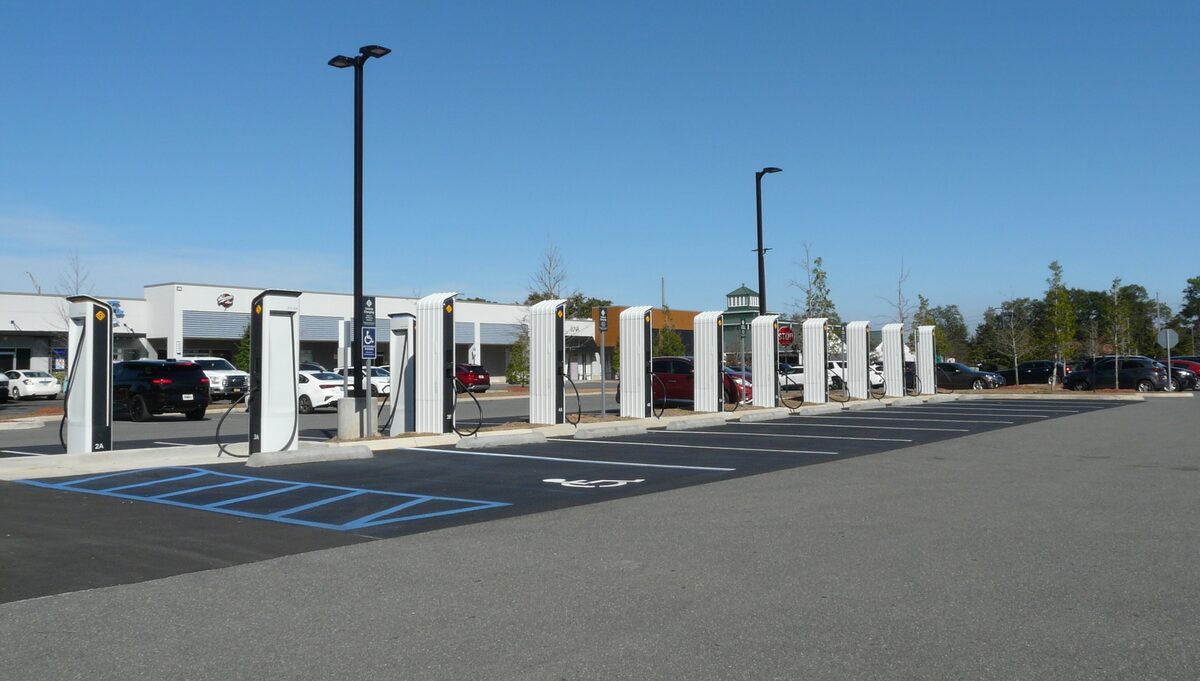
The California Energy Commission (CEC) placed a $4,548,470 grant to Rivian, LLC on the consent calendar of its October 19, 2026 business meeting. The grant would fund 94 public DC fast-charging ports at nine stations. Three locations are named: Big Sur on State Route 1, Coachella and San Clemente. The other six are still to be determined. The money comes from California's National Electric Vehicle Infrastructure (NEVI) Formula Program. The grant pays for construction that has not happened yet. None of the nine stations is open.
According to the commission's revised final agenda, item 3r was a proposed resolution approving agreement RNEV-26-001, under which Rivian would "install, operate, and maintain 94 public EV DCFC ports across nine charging stations in Big Sur, San Clemente, Coachella, and six sites to be determined." The meeting was scheduled for 9 a.m. to 1 p.m. Pacific time at the California Natural Resources Building in Sacramento. Consent calendar items are taken up and voted on as a group unless a commissioner asks to move one for separate discussion.
Where the money goes
The backup materials for item 03r title the effort the "Rivian, LLC – NEVI 3 Project." The funding is federal NEVI reimbursement money with a 2023 appropriation year. The agreement term runs from October 19, 2026, through March 31, 2033. The scope of work lists new CCS ports and total new charger power for each station:
| Location | Address | New CCS ports | Total new charger power |
|---|---|---|---|
| Big Sur | 46840 California 1 (SR-1), 93920 | 6 | 900 kW |
| Coachella | 48055 Grapefruit Boulevard, 92236 | 12 | 1,800 kW |
| San Clemente | 101 W Avenida Vista Hermosa, 92672 | 12 | 1,800 kW |
| Four sites to be determined | TBD | 12 each | 1,800 kW each |
| Two sites to be determined | TBD | 8 each | 1,200 kW each |
The three named stations account for 30 ports and the six undetermined sites for the remaining 64. At every station, the listed power works out to 150 kW per port. The agreement allows the number of ports, power levels and ports per station to change with written approval from the CEC's agreement manager. If the port count goes down, the CEC can cut the grant in proportion.
Every station must meet the program's baseline. It has to be publicly accessible and have at least four DC fast chargers rated at 150 kW or more with Combined Charging System (CCS) ports. It must be able to charge four EVs at 150 kW or more at the same time and have at least 600 kW of station power. It also has to meet the federal minimum standards in 23 CFR 680.
The budget splits the CEC money among three vendor lines, each with a matching contribution:
- Rivian Automotive, LLC: $3,478,000 from the CEC and $869,500 in match
- B2 Sales, Inc.: $280,000 from the CEC and $70,000 in match
- Vendors to be determined: $790,470 from the CEC and $197,618 in match
Together the match lines add $1,137,118 to the grant.
How the award got here
The CEC administers California's NEVI formula program under an agreement with the California Department of Transportation (Caltrans). On December 29, 2025, it released GFO-25-602, titled "California's National Electric Vehicle Infrastructure Formula Program – Solicitation 3." The round funds publicly accessible, high-powered DC fast chargers along major travel corridors in California. Rivian submitted application #1, and the CEC proposed it for funding in a Notice of Proposed Awards dated July 14, 2026. The October 19 business meeting came 97 days after that notice.
Approval by the commission does not start construction. The grant is reimbursed with federal NEVI funds, and the Federal Highway Administration must authorize funding for the project before reimbursable or match-share costs can be incurred. Caltrans approval may also be needed before work begins.
Rivian's item was one of several EV charging grants on the same consent calendar. According to the agenda, items 3k through 3q went to recipients including the Los Angeles Department of Transportation, LA Metro, the City of Los Angeles, Highland Electric Fleets, the Los Angeles Unified School District, Centralia Elementary School District and the Los Angeles Cleantech Incubator. The commission posted the backup documents for each item in its supporting materials for the meeting.
What It Means for Drivers
None of these chargers can be used yet. The October 19 item covers the funding agreement, not construction or operation, and the CEC record gives no opening date for any site. Until a station shows as operating in the AFDC station locator, treat it as funded and planned, not open.
Drivers on Highway 1 along the Big Sur coast should look for a station at 46840 California 1. The Coachella Valley site is on Grapefruit Boulevard in Coachella, and the south Orange County site is on Avenida Vista Hermosa in San Clemente. The other six stations have no locations yet. Their port counts and power could still change with the CEC's approval, so the totals may shift before anything is built.
The agreement requires every station to be publicly accessible, so the chargers are not limited to Rivian vehicles. Once a station opens, Rivian must operate it for at least five years and run a warranty and maintenance program that keeps station uptime at 97% or higher.
