
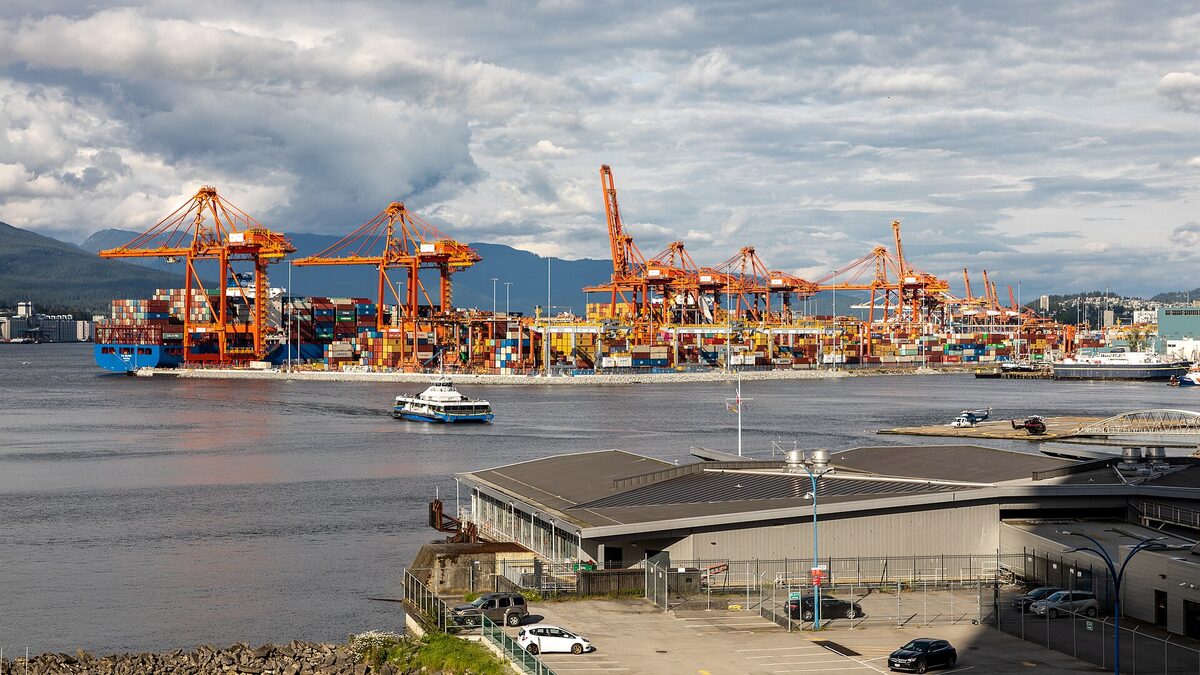
Finnish charger maker Kempower has signed a multi-site framework agreement with DP World Canada that covers all five of the port operator's Canadian terminals: Vancouver, Fraser Surrey, Nanaimo and Prince Rupert in British Columbia, and Saint John, New Brunswick. Electric Autonomy reported the deal on Sept. 24, 2026. The first phase, at Vancouver, Fraser Surrey and Prince Rupert, calls for 46 satellite chargers with a combined 4.4 MW. Its aim is to standardize equipment and support electrification of service vehicles and container-handling machinery. Doug Smith, CEO of DP World in Canada, said the agreement provides "a scalable, reliable charging platform."
A separate Kempower project in the same port is already running. Kempower and its Canadian partner, EVlution Charge, have commissioned 21 dual-plug Kempower Satellites at Global Container Terminals' (GCT) Vancouver operation, giving the terminal 42 fast-charging plugs and 2.05 MW of available charging power. The chargers were installed earlier in September. In a Sept. 14 announcement, Kempower said the system is operational for GCT's service vehicle fleet and daily terminal operations.
Two Port Projects, Two Stages
The two deals are at different stages.
| Operator | Sites | Hardware | Power | Status |
|---|---|---|---|---|
| GCT | Vancouver | 21 dual-plug Satellites (42 plugs) | 2.05 MW available | Operational |
| DP World Canada, Phase 1 | Vancouver, Fraser Surrey, Prince Rupert | 46 satellite chargers | 4.4 MW combined | First phase of framework agreement |
| DP World Canada, other sites | Nanaimo, Saint John | Not yet specified | Not yet specified | Covered by framework agreement |
DP World is also building a new terminal at Contrecoeur, near the Port of Montreal, which is expected to be finished by 2030.
How the Chargers Are Set Up
Kempower's Satellite design separates the power cabinets from the dispensers that vehicles plug into, so one power system feeds several charge points. Electric Autonomy reports that the GCT system uses dynamic power sharing: power at each port can be raised or lowered based on vehicle needs and fleet schedules, supporting both scheduled and opportunity charging. Jed Routh, Kempower North America's vice-president of markets and products, said the chargers can run at about 25 kW, similar to a Level 2 charger, which avoids demand charges. "If you need a lot of power fast and it's available, we can give it to you," he added.
That flexibility fits how GCT runs its equipment. Instead of pulling vehicles out of service for long charging sessions, the terminal uses opportunity charging during shift changes and breaks. Kyron Harvett, GCT's manager of operations technology, said in Kempower's announcement that GCT chose Kempower for its charging density, reliability and flexibility. He cited GCT's own trial of a heavy-duty battery-electric terminal tractor that ran around the clock for several days on opportunity charging alone, with near 100% uptime. That is the terminal's own result for one vehicle, not an independent measurement or a fleet-wide figure.
Who Is Involved
EVlution Charge, Kempower's official sales and service partner in Canada, delivered the GCT project and maintains it. George Ivanchikov, its president and co-founder, said in the release that this gives GCT one team accountable for all 42 plugs. Monil Malhotra, president of Kempower North America, said the deployment shows how Kempower's systems can support shared charging for container-handling equipment and large service vehicle fleets.
GCT runs two terminals, GCT Vanterm in Vancouver and GCT Deltaport in Delta, which together handle more than 3 million TEUs (twenty-foot equivalent units) a year, according to Kempower. The company has set a target of a 45% absolute reduction in emissions by 2030. GCT is also a finalist for the 2026 Canadian Clean Fleet Awards, launched by Electric Autonomy with the Pembina Institute. Winners will be announced at a ceremony in Mississauga, Ont., on Nov. 4.
Context
GCT operates Canada's largest container terminal, and DP World is already a Kempower customer: Kempower supplied DP World's London Gateway hub in the U.K. in 2024. Routh called ports "the absolute sweet spot for an electric vehicle." On funding, Electrek points to a potential relaunch of federal Diesel Emission Reduction Act (DERA) grants and to new incentive programs that ZET TRUCK is launching to help offset the up-front costs of electrification. Neither is described as committed funding for these projects.
What It Means for Drivers
None of these chargers is for passenger EV drivers. The GCT installation and the DP World sites are depot chargers inside working container terminals, built for terminal tractors, service vehicles and container-handling equipment. They won't appear as public stations in charging-network apps.
The news matters more to port fleet operators and the people who drive terminal equipment:
- At GCT Vancouver, electric service vehicles can charge on site during the working day, with crews topping up at shift changes and breaks instead of parking vehicles for long sessions.
- At DP World's Vancouver, Fraser Surrey and Prince Rupert terminals, the Phase 1 chargers come under the new framework agreement. Operators with equipment at those sites should confirm with DP World Canada which chargers are in service before planning electric equipment around them.
- At Nanaimo and Saint John, the agreement covers the terminals, but no phase or hardware count has been published.
Sources
- Kempower and EVlution Charge advance port terminal electrification in Canada at Global Container Terminals in Port of Vancouver (Kempower, Sept. 14, 2026)
- Kempower deals charging up two major Canadian port operations (Electric Autonomy, Sept. 24, 2026)
- New Kempower charging deal powers up Canadian port operations (Electrek, Sept. 26, 2026)
