
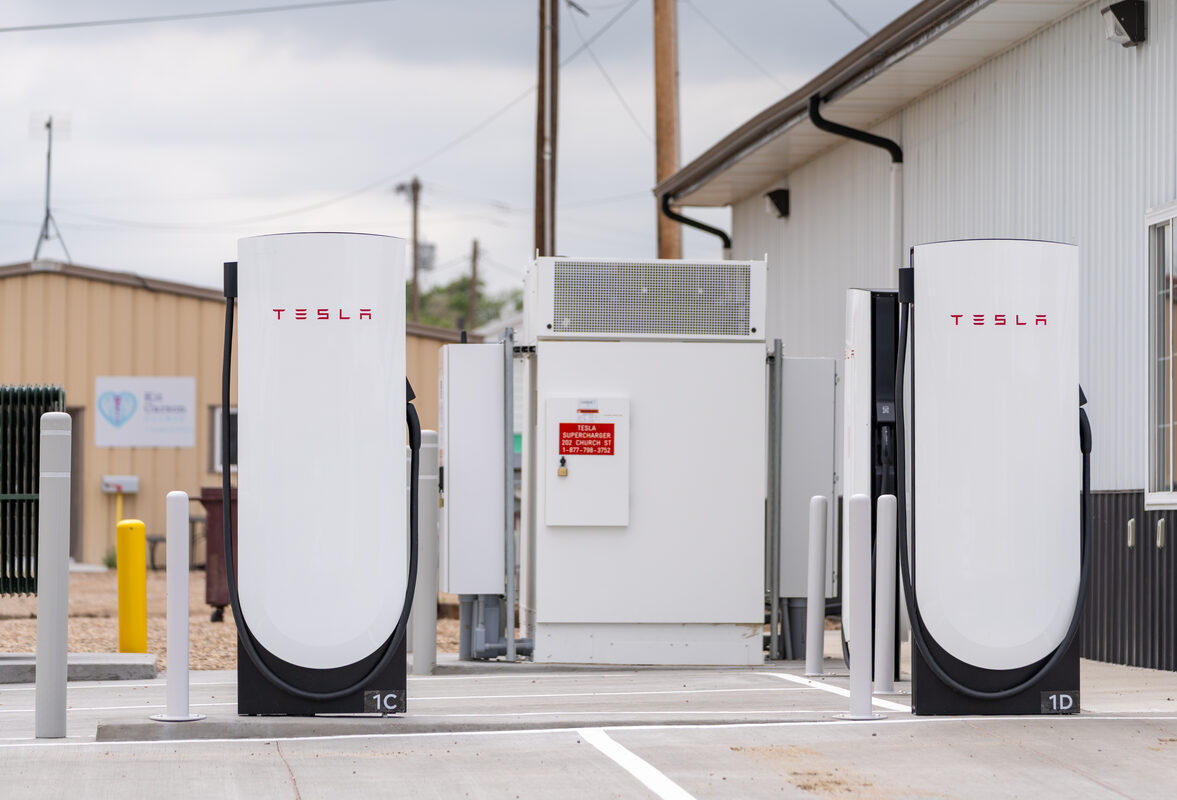
Public DC fast-charging operators in the US added 664 stations and 4,106 ports from July through September, according to Paren's Q3 2026 fast-charging report, published October 13. The national network now stands at 14,614 stations and 80,964 ports, the first time it has passed 80,000. Paren, an EV-charging analytics firm, says it monitors more than 98% of US fast-charging infrastructure in real time; its figures cover publicly accessible ports as of September 30.
Tesla is still the largest builder, but its grip on the installed base is loosening. Paren puts Tesla's share of all US fast-charging ports at 49.3%, down from 54.3% a year earlier.
Paren also changed its counting this quarter. Totals now exclude retired chargers and sites, ports count as new when a new owner replaces the hardware at an existing site, and average prices exclude free chargers, with earlier quarters recalculated. The report warns that comparing its totals with older editions may show discrepancies.
Fewer new stations, bigger ones
Through the first three quarters of 2026, operators opened 2,158 stations, about 20% fewer than the 2,696 opened over the same stretch of 2025. Ports held up better: 12,354 so far this year, roughly 9% below last year's 13,600. The gap is site size. New non-Tesla stations averaged 5.0 ports, up from 4.1 a year earlier, and new Superchargers averaged 13.1 ports. Tesla opened 11 sites with 24 or more stalls, and Electrify America opened its largest site to date, with 24 ports.
For pace, the year's heaviest quarter may still be ahead. Operators opened 6,191 ports in Q4 2025, and Paren writes: "We expect a similar push through the final weeks of 2026."
Construction remained concentrated in cities. Rural markets received 68 of the quarter's new stations, about 10% of the total. California added 87 stations, down from 128 in Q2, while Texas rose to 66 from 54.
Who built
Tesla added 1,287 ports, 31.3% of the quarter's total, or 1,411 (34.4%) counting 124 ports at Supercharger for Business sites. A year earlier it added 1,744 ports, 37.4% of that quarter's total. The quarter also brought 26 new sites with Tesla's 500 kW V4 cabinets, for 42 such sites and 487 ports nationally.
| Network | Ports added, Q3 2026 |
|---|---|
| Tesla | 1,287 (1,411 with Supercharger for Business) |
| Ionna | 378 |
| Walmart | 344 |
| Red E | 202 |
| Electrify America | 186 |
| ChargePoint | 169 |
Ionna more than doubled its Q2 total of 182 ports to take second place, much of it from converting 44 former Circle K sites. It also opened its first NACS-only stations, in Lancaster and Perris, California, with four ports each; Rivian opened three NACS-only sites. Across non-Tesla networks, 677 new ports, or 23% of new connectors, were NACS (SAE J3400), up from 9% a year earlier. CCS still made up 74% of new builds.
More power per port
Of all ports added in Q3, 73% are rated at 250 kW or more, up from 60% a year ago. The bigger shift is at the top end: 35% of new non-Tesla ports are rated 400 kW or higher, against 10% a year earlier. About one in eight new installs is below 150 kW.
Busier, but not fuller
Drivers started 50.4 million fast-charging sessions in Q3, up 26% from 39.9 million a year earlier. July set a monthly record at 17.6 million. Because the network grew too, average utilization barely moved: 15.9%, against 15.8% in Q2, a figure that has stayed between 15.7% and 16.5% for five straight quarters. The 30 largest metro areas ran at 21.1% and the rest of the country at 11.0%. Los Angeles was the busiest metro at 31.8%.
Paren's reliability score, its own measure that weighs successful sessions, retries, failed attempts and downtime rather than a plain uptime percentage, was 93.9 nationally, up from 93.7 a year ago. Fifty of 52 states and territories scored 90 or higher; Oklahoma (80.8) and Vermont (86.9) did not.
Prices
These are Paren's Q3 2026 quarterly averages, published October 13, not quotes for any particular station:
| Category | Q3 2026 average | Year-over-year change |
|---|---|---|
| National | $0.540/kWh | +2.7% |
| Tesla, non-member | $0.569/kWh | +15% |
| Tesla, member | $0.396/kWh | +9% |
| Non-Tesla | about $0.533/kWh | Roughly flat for five quarters |
Most per-kWh stations, 72.9%, charge a fixed rate; the 27.1% that use time-of-use pricing averaged $0.637/kWh at peak and $0.438/kWh off-peak. Hawaii was the most expensive state at $0.877/kWh and Nebraska the cheapest at $0.424/kWh. Paren attributes the national increase to Tesla, Electrek reported.
What It Means for Drivers
- Superchargers cost non-members more than they did. Tesla's non-member average rose faster than its member average over the year, so the premium for charging at a Supercharger without a membership has widened.
- Some new stations take one plug only. Ionna's Lancaster and Perris sites and Rivian's three new sites are NACS-only. Owners of CCS1-port vehicles should check the connectors listed for those specific locations before relying on them.
- Former Circle K chargers have changed hands. Ionna took over and replaced the equipment at 44 former Circle K sites this quarter, so those locations now operate as Ionna stations.
Sources
- Paren: US EV Fast Charging — Q3 2026 (October 13, 2026)
- Electrek: Tesla still leads US fast-charger growth – but it's raised its prices (October 13, 2026)
- EV Infrastructure News: US fast charging network surpasses 80,000 ports in Q3 2026, Tesla's market share dips below 50% (October 13, 2026)
- MGRID: US fast chargers pass 80,964 ports, but utilization stays flat at 15.9% as Tesla raises prices (October 16, 2026)
